
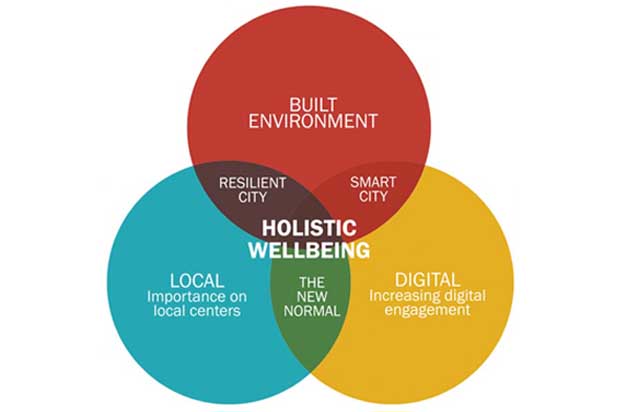
Cities have long been hailed as centres of social, cultural, economic and political changes and advancements. As more and more human experiences are becoming predominantly urban, the need to achieve resilience is turning into a global prerogative. Designing to respond to this state of constant flux has been a persistent challenge. This intent has been put to test this past year, bringing into focus multiple perspectives, in order to revive, review and renew the core principles and intentions of urban living itself. At the very heart of which is the idea of holistic wellness and what it means for our very survival.
Health and the City
The concept of ‘health’ in cities is constantly evolving, and it often varies as it traverses across a general cross-section based on its socio-economic construct and cultural practices. Traditionally, the idea of health was limited to providing access to healthcare and basic amenities related to the physical aspects of health. While these remain core concerns in many parts of the world even today, there is a growing awareness towards examining how human environments can facilitate cities that thrive and are healthy and happy by virtue of strategic design interventions.
From the early ’80s through to the ’90s, the World Health Organisation set up the ‘Healthy Cities Approach’ (1), which gained popularity in Europe and beyond. The requirements of a healthy city were stated as, “The place or social context in which people engage in daily activities in which environmental, organisational and personal factors interact to affect health and wellbeing.” Such an environment, or setting was not limited to the current health infrastructure. The approach also evaluated the actions upon which the city forges the necessary networks of political, economic and social arenas. Right from its onset it was clear that while the idea of a ‘Healthy City’ is relative, the common aim that it engages in ensures liveable environments that allow all its inhabitants to have equal access to holistic wellbeing.
The Perception of Wellness and the City
Holistic wellness goes beyond physical health and includes mental wellbeing as well.
This is further reinforced by a dynamic equilibrium that should exist between the duality of the built and unbuilt, the formal and organic, the physical and digital but, most importantly, nature and man.
The viability of all of these are critically linked to efficient integration of policies across stakeholders and various systems involved. As people are becoming mindful of the impact of their immediate surroundings on their overall wellbeing, designers associated with the built environment are starting to consider the social aspects of spaces to improve quality of life and ensure wellness for individuals and communities alike. The growing association between cities and mental wellness has put emphasis on the need for sensitively designed environments. It is this trilogy between people, places and a sense of belonging that contributes to fostering strong, healthy communities. More importantly, seeking a sense of balance between social, economic and physical conditions to facilitate a sense of overall happiness.
As cities contend with availability of limited resources, optimisation becomes key. In order to prepare for the forces of urbanisation, city labs and governments around the world have been investing in research and novel technologies to make the next Smart City. But is a Smart City a healthy city? Is it enough to invest only in smart, physical infrastructure, with little consideration for social inclusivity? The social structure humanises a city, giving its people a sense of belonging, which in turn creates inclusive healthy environments. While nothing can replace the power of in-person social interaction, the past year has demonstrated the importance to find a balance between the essence of community and emerging digital relationships to match pace with the physical. The primary aspiration should be to extend the definition of a city to go beyond being only centres of economic growth and to become centres of wellness.
Designing for Happiness
Cities have been evolving since their inception.
Every few hundred years, we see the ‘release’ of a stronger, more updated model, be it the Garden City, the Industrial City, the Smart City, or even the more recent, Resilient City.
City design concepts have therefore dictated several aspirational standards over the years. However, it is often overlooked that the point of commonality in this urban evolution are the people who make the city. This makes it all the more pertinent to bring back the focus on the wellbeing of people. One way to explore this possibility is to weave in holistic wellness into the very core of all urban systems.
The question of designing holistic wellness into the DNA of our cities is tricky, since there are no absolute solutions and contextualisation is key. Yet amongst urban designers, planners, architects, anthropologists, geographers and psychologists there has always been a fascination with the need for tangible guidelines instead of concentrating on a universal standard for wellness.
Components of a Complete Neighbourhood
Perceiving the city as the sum of all its parts that are smaller, systemic, decentralised environments, neighbourhoods become the ideal testing ground to reimagine this new standard for wellness. The scale also makes it ideal to effectively read connections between its systems and how they can contribute towards urban health. Healthy neighbourhood design is facilitated by land use decisions which prioritise complete, compact and connected communities. These communities are more likely to support walking, cycling and the use of public transport. It is important to note that aiming for compact neighbourhoods does not just mean high density. It means focusing on efficient planning and sensitive design to achieve a compact urban form.
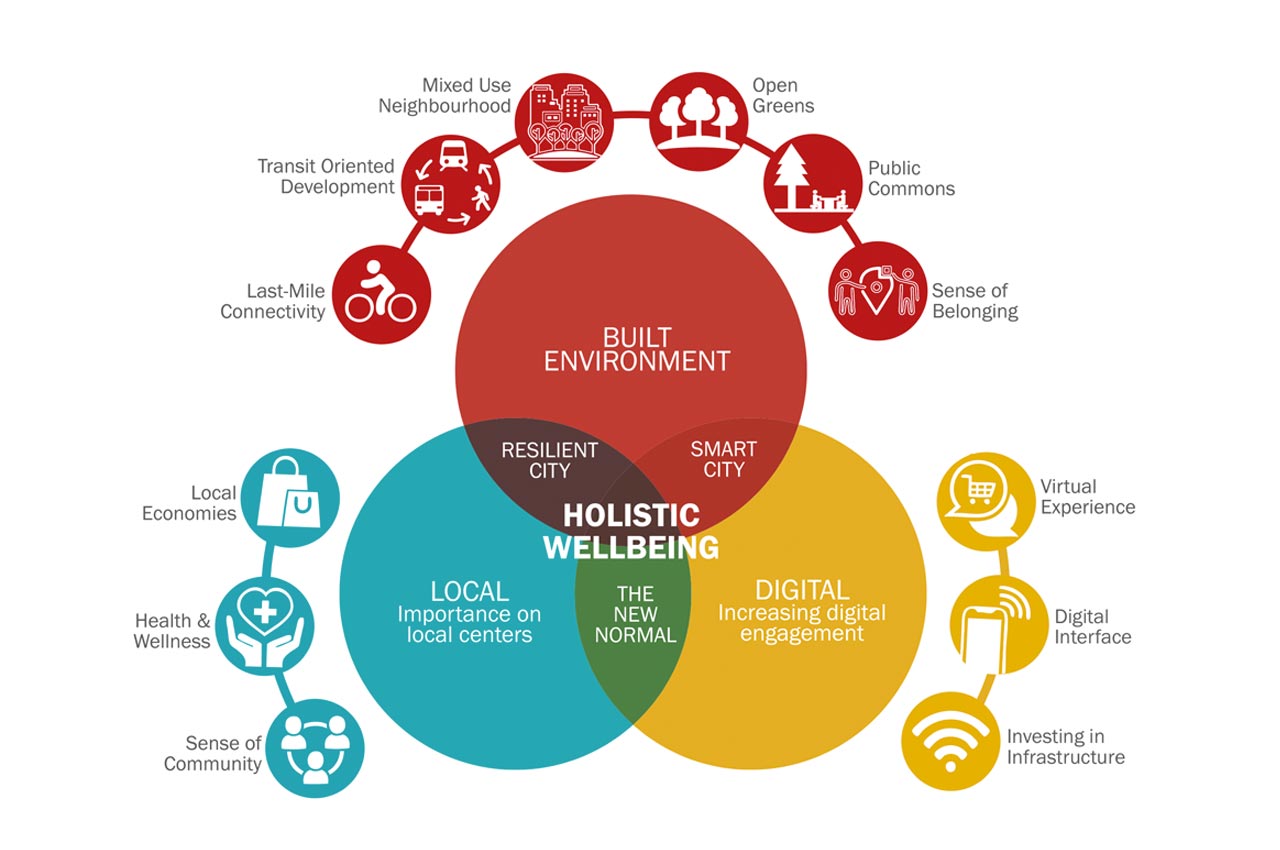
The components that contribute towards holistic environments are mixed use developments, access to open greens, vibrant public spaces, efficient and well-planned public transport systems and safety.
Mixed-Use Neighbourhoods
Mixed-use developments can have a great impact on health and wellbeing at an individual as well as community level. The idea hinges on the concept that people can access daily needs and amenities within a walkable distance from their homes, while equally enhancing their health, socio-cultural liveability and overall sense of belongingness.
This thereby facilitates a wholesome approach to access and ‘Right to the City’. These mixed-use developments promote an integrated environment, optimise resources and encourage sustainable and shared living. They facilitate community partnerships by means of a bottom-up approach and inculcate a sense of ownership for the urban environments they live in. The model explores the benefits of living entrenched in our local communities, one that extends benefits to local businesses, and celebrates opportunities for daily, informal social interactions.
Access to Open Greens
Cities with neighbourhoods that have access to natural systems such as forests and water bodies are often proclaimed to be healthier. Studies have shown significant impact on mental and physical wellbeing of people by merely having everyday access to green and natural environments. Enhanced city and green infrastructure partnerships, which operate at different scales, allow for compounded community benefits. They also help modulate the micro climatic impacts and essentially function as ‘health filters’ for the city.
Vibrant Public Spaces
Healthy public spaces are vital to the health of communities. An effective public space is one that allows social interactions to build and thrives on generating a sense of belongingness among individuals. They help build a sense of community, civic identity and culture. These are spaces of all sizes and order and are everywhere. Some are designed while most developed organically, ranging from designed plazas, parks, grounds, boulevards, museums, malls, gymnasiums, cinema theaters, public buildings, to the back alleys, stairways, and sometimes makeshift spaces and urban pop-ups that thrive between the private places that are often undersutilised assets of the neighbourhoods.
These opportunities of shared urban commons are key to shape communal health.
Integrated Transportation Networks
Making public transportation convenient and safe for all could play a critical role in daily choices enabling convenience in getting around the city. Sensitively planned supporting infrastructure in the public realm like footpaths and last mile connectivity are all fundamental in improving the efficiency of transport systems. When transportation networks are designed to prioritise access and people, mobility for all residents is encouraged. This leads to improved health outcomes, better physical and mental well-being and greater opportunities for social connectedness. Seeking the right balance of a vibrant street life, integrated with efficient public transportation brings diverse neighbourhoods together. A focus on this balance not only provides for enhanced urban living conditions but also happy citizens.
Going ‘Back to the Future’ of Neighbourhoods
Restrictions during the recent lockdown meant that people could not engage in their normal day- to-day activities for an extended period of time. As these restrictions eased, the movement of people was limited to their ‘local centres’, highlighting the importance of vibrant local centres and high streets. These ‘local’ movements of people saw a resurgence of the local economies and businesses that were otherwise being ignored for large popular chains. These re-established connections have further emphasised the need for self sufficient neighbourhoods with their own intrinsic ecosystems.
Over the years, we have grown increasingly dependent on our digital devices. The past year has clearly demonstrated that there is merit to invest in and focus on local digital ecosystems. Not only are we experiencing our neighbourhoods physically, but we’re experiencing them digitally as well. (2) While we have been forced to follow norms of social distancing for our safety, we are more digitally connected than ever before. The pandemic has left a far-reaching impact on everyday life and challenged conventional thinking in various sectors to fast forward by 5-10 years, including how people access healthcare. It would be easy to hold on to the belief that this time of worldwide emergency too shall pass and everything will go ‘back to normal’.
However, it would be more pragmatic to believe that there is no return to what used to be considered normal.
Wellbeing affects every part of our lives. It reflects physical and mental health, economic security, social connections and sense of purpose. We are simultaneously becoming more local and digital, and this new normal might hold the potential to become a once in a lifetime opportunity to bring the focus back on holistic wellbeing and how we can design our built environments around this principle as a guiding force.
(1) The Ottawa Charter, (1986) World Health Organization. Available from https://www.who.int/healthpromotion/ healthy-settings/en/
(2) The New Local: Data Report - A new perspective on our cities. www.neighbourlytics.com

Comments (0)