
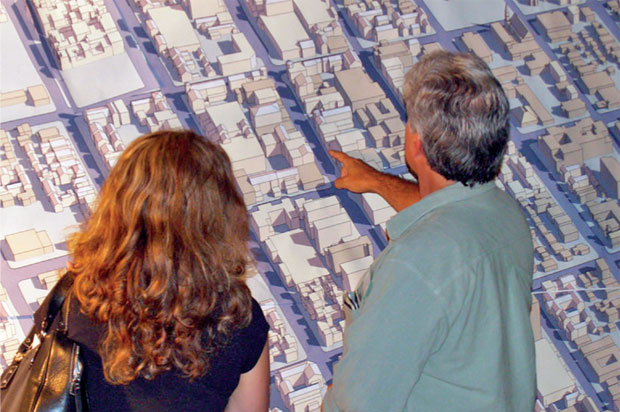
Vinayak Bharne (VB): Your first book, Planning for the Unplanned: Recovering from Crises in Megacities, which came out in 2005, made a provocative argument: That a crisis can become a real barometer to gauge a planning institution’s strengths and weaknesses and that cities presumed to exemplify poor planning are often more resilient and successful in the wake of disasters. So, looking back, what are some of the key themes and takeaways of this study that seem most significant today?
Aseem Inam (AI): I wanted to achieve two main things with that book. One was to find out when, how and why generally lethargic and bureaucratic planning institutions are effective and the other was to compare how such institutions behave in the global north versus the global south.
The answer to your first question is: Yes, bureaucratic institutions like government agencies can be extremely effective during periods of crises like earthquakes. Successful agencies are good at quickly applying established policies, programmes and procedures (i.e. institutional routines) to crises by adapting them to the specific needs of the moment. For example, Los Angeles used its database of the rental housing market and experience with housing finance to quickly and effectively rebuild neighbourhoods after the 1994 earthquake.
The answer to the second question is that cities in the global south (i.e. Africa, Asia and Latin America) are often more effective than those of the global north (i.e. Europe, North America) by being innovative and resourceful. As an example, Mexico City got a lot more housing rebuilt and repaired after its 1985 earthquake than Los Angeles did after its 1994 earthquake, and it has to do with being really resourceful. If we look for them and analyse them properly, we can find extraordinary examples of successful public sector urban planning initiatives, especially in the cities of the global south.
(VB): We recently had two major back-to-back earthquakes in different parts of the world: Japan and Ecuador. Both these places are considerably different in their technological prowess, governance structures and preparedness for such events. From your studies in Mexico and Los Angeles, how do you see different cities reacting to such situations differently, yet towards the same end goals and what can they learn from one another?
(AI): That’s an excellent question. There are two traps that people fall into when talking about cities: every city is the same (e.g. universal theories and solutions, such as ‘best practices’) or every city is different (e.g. “This only happens in Mumbai and nowhere else in the world.”).
The reality is that cities are similar in some ways and different in others.
We can learn by asking powerful questions such as: What works in each context and why? For example, in Mexico City, which was supposed to have a strong government but weak community organization, it was in fact grassroots community mobilization that made things happen. On the other hand, in Los Angeles, which was supposed to have lots of neighbourhood activity but relatively less government initiative, it was the opposite: people simply abandoned their neighbourhoods after the earthquake and it was the local government that turned things around. Each city has its own strength e.g. excellent social movements in Mexico City, excellent local government in Los Angeles. Different cities can and should learn from one another, but it is important we don’t let our often Euro-American-centric bias think that all urban solutions lie in the global north.
(VB): Your second book, Designing Urban Transformation, argues for fundamental shifts in urban design practice, demonstrated in part through your diverse experience across cultures, as well as your experimental projects in both the academic and mainstream worlds. Could you elaborate on this with regards to the shifts you talk about and the experimental efforts that led you to them?
(AI): We need a radically different approach to urbanism that fits the complex, constantly changing and unpredictable nature of cities. I talk about three fundamental shifts: beyond objects – city as flux; beyond intentions – consequences of design and beyond practice – urbanism as a creative political act.
I taught a studio at MIT where I used my background in comedy improvisation to develop new design methodologies to shape cities that are constantly changing. As an example of consequences of design, I was part of a team with Joseph Stein that designed the India Habitat Centre, New Delhi as a new urban centre and ecological campus in which spaces and facilities are shared with public, private and nonprofit organisations working on housing and infrastructure. For the third shift of urbanism as a creative political act, I led a team with Stefanos Polyzoides to redesign a historic centre near Los Angeles in ways that were extremely democratic, and in which we dealt extremely creatively with politics as part of the design process. I actually started developing these shifts in design practice much earlier, when I worked in the villages of India for the Geneva-based Aga Khan Development Network. At that time, we pursued projects such as a day care centre or low cost housing as part of a long-term and systemic effort in collaborative and transformative practice. So, I’ve been developing these new modes of design practice for many years now in collaboration with others and, fortunately, this process has worked extremely well.

(VB): Soon after the release of Designing Urban Transformation you started an experimental research-based practice, TRULAB: Laboratory for Designing Urban Transformation.Tell us about it.
(AI): TRULAB is an experimental research-based practice that focuses on nothing less than the fundamental transformation of our cities. Many exciting new ideas are generated through serious research, which is why I believe in the power of books. Other ideas emerge as theory (i.e. patterns that explain and guide practice) out of reflecting on practice.
Apart from research and theory, a third crucial area for generating the new knowledge we need for 21st century cities is testing ideas by actually carrying them out. TRULAB is the venue for such cutting-edge practice.
In Haiti, I was part of a team from MIT, Oxfam and the World Bank that was invited by the government after the devastating earthquake of 2010. Our task was to design a housing rebuilding strategy for the capital, Port au Prince, as well as the rest of the country. The main thing that was different about our work was that we didn’t just look at the problems, we also built upon existing assets e.g. the incredible resilience and entrepreneurship of the Haitian people, local construction knowledge to survive earthquakes and grassroots efforts in building low-cost housing.
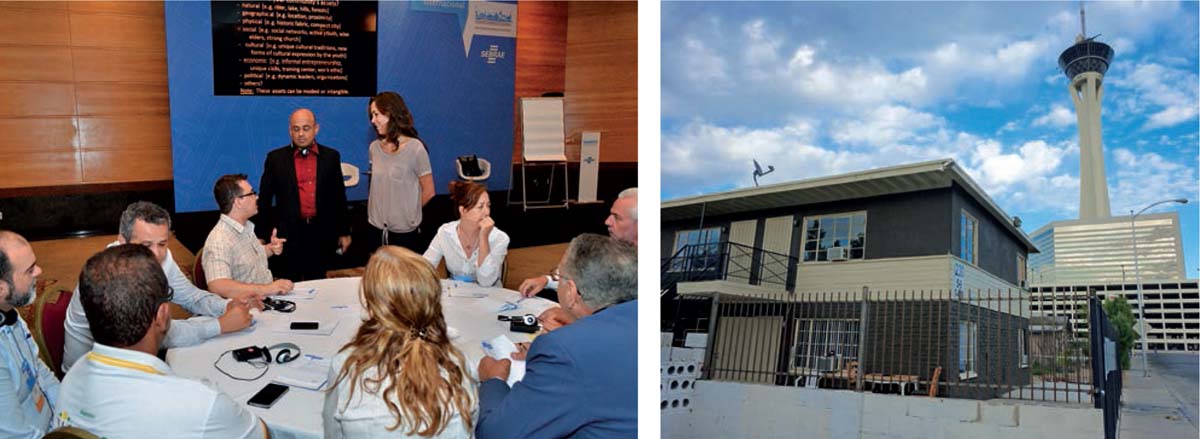
Right: Las Vegas offers surprising and valuable lessons for cities today, such as why patterns of urban development happen the way they do
TRULAB was also invited to Brazil by a government agency called SEBRAE to work with mayors and develop strategies for urban transformation in smaller cities. Our strategy was to develop a simple methodology of letting each mayor and their teams work out the promising paths to transformation. For example, for one city it might be leveraging its history, while for another it would be its social networks and for a third it might be its valuable location. By the end of our workshop, each mayor had developed a specific strategy that would be further fleshed out in each city. The mayors were extremely pleased with this interactive and creative mode of transformative practice. We continue to do such innovative work, most recently in Toronto.
(VB): Your forthcoming book is about Las Vegas, which for me remains one of the most intellectually intriguing cities in the United States, along with New York, Los Angeles and Detroit. Why do you find Las Vegas so interesting and what is its relevance to other cities?
(AI): Las Vegas is a fascinating city because most people love to go there but many also love to hate it. In 1999, it became the most visited place on earth! At the same time, there are so many stereotypes about it: that everything is fake, that it is the place of excessive consumerism, that there is no real community there, that it wastes a lot of water and energy and so on. Some of that might be true, but what is more interesting is what Las Vegas reveals about the true nature of contemporary cities.
For example, my research on Las Vegas shows that public-private partnerships – which are very fashionable right now – actually benefit private profit at great public cost.
Another insight that Las Vegas reveals about cities is that they are ‘designed’ in many different ways, through political processes, public policy, behind-the-scenes negotiations and, most of all, through informal decision- making by powerful interests. An excellent way to learn about this is through the work of good urban historians. Las Vegas has an absolutely fascinating history that most people don’t know about. By understanding this reality, we can actually work with it and, ultimately, change it for the better. I have already presented this research in Las Vegas itself and it’s been very well-received.
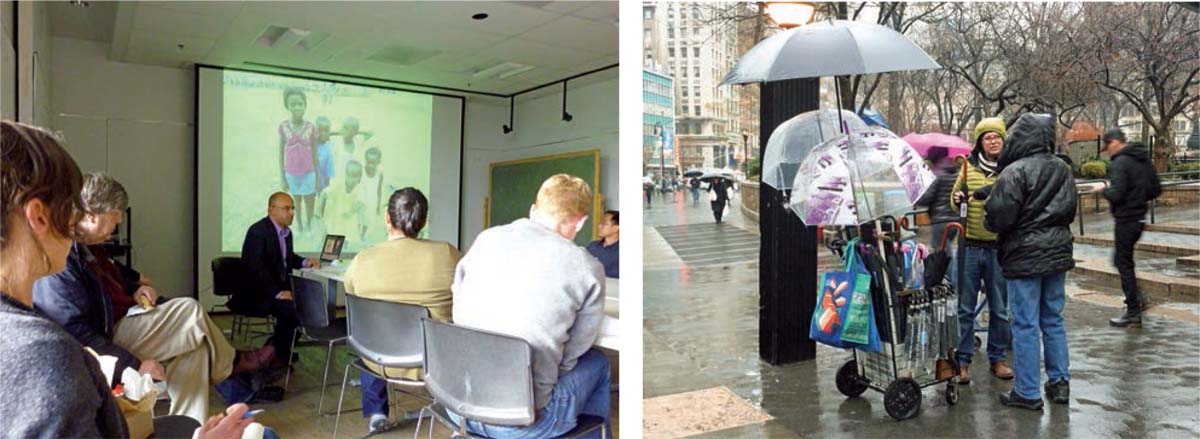
Right: TRULAB worked with the Parsons School of Design to redesign the interaction between street vendors and public space in Union Square, Manhattan
(VB): You have worked as an architect, urban designer and city planner all over the world in places like Brazil, Canada, France, Greece, Haiti, India, Morocco and the United States. You have lectured and taught internationally. You speak several languages and have lived in several parts of the world. How has this transformed your outlook on what cities and urban practice means?
(AI): Our world has always been global, but the 21st century has seen a rapid increase in the exchange of ideas, people, money and goods across the world. We have to be both local and global. Being urban means to be immersed in a specific historical, cultural, economic and political context and engaging with communities locally. At the same time, it is essential that we understand global political-economic systems that have local impacts that we learn from but don’t copy and that we learn to collaborate internationally. At a basic level this not only means that more and more of us need to be multilingual, but also that we are more critical in our thinking and more self-reflective on what works and what doesn’t.
At another level, we need to be absolutely immersive, even if we have a few days to spend when visiting a city like Shanghai, it’s important to walk, smell the air, talk to people and understand what it means to live and work there; that is, try to understand a place from the inside out. Overall, what I have learnt from my global experience is that we can be far more effective practitioners if we are more sensitive to others, if we learn their language, if we interact with them and if we are both more bold e.g. by venturing into new and often uncomfortable territories and more modest e.g. being open to really learning from and working with people in different parts of the world. This is truly the way forward in an increasingly globalising world of cities.
(VB): There has never been a greater interest in the future of cities from disciplines beyond the planning field than today, and terms like liveability, sustainability, resilience and smart cities are all over the place. Given your extensive experience as a practitioner, researcher, teacher and activist, what is your perspective on the future of our urban planet?
(AI): My perspective on the future of our urban planet is multifaceted and optimistic. First of all, it is absolutely crucial to learn about the past and understand the present in order to actually transform the future of cities. Second, we have to make sure that words like ‘liveability’ and ‘smart cities’ are not just superficial ‘feel-good’ ways of thinking about cities. Third, in order to meaningfully improve our cities, we have to drastically change how we design them, making them more democratic, more equitable and making them places where everyone has equal opportunities. Fourth, we need radical new ideas and ways of ‘designing’. Our training is outdated and has been for a very long time. For example, in college architects never really learn that projects are always designed in teams. Another example is that designers celebrate doing things in new and innovative ways; I call this the ‘tyranny of novelty’ e.g. what is ‘sexy’ but superficial.
Fifth and finally, I am extremely passionate about cities and extremely hopeful about their future. This is because there is brilliant work being done by urbanists right now, but they are not necessarily the famous ones.
Three of the best ones of our generation are Teddy Cruz in San Diego, Miguel Robles-Duran in New York and Perween Rehman in Karachi. Another sign of great hope is the younger generation of students and recent graduates, who are extremely talented, intelligent and, most important, committed to urban transformation. They are doing things in exciting ways and blazing new trails, for example in Sao Paulo. Yet another sign of hope is that urbanists are finally realising that doing is not enough; you really have to think seriously about what you’re doing.
Ultimately, to be a brilliant urbanist, you have to understand and work with or against he politics of the city. Stefanos Polyzoides in Los Angeles, Sam Stein in New York and Gautam Bhan in Delhi are all doing that and accomplishing great things. So, yes, we are all part of this growing international movement in urban transformation.

Comments (0)