
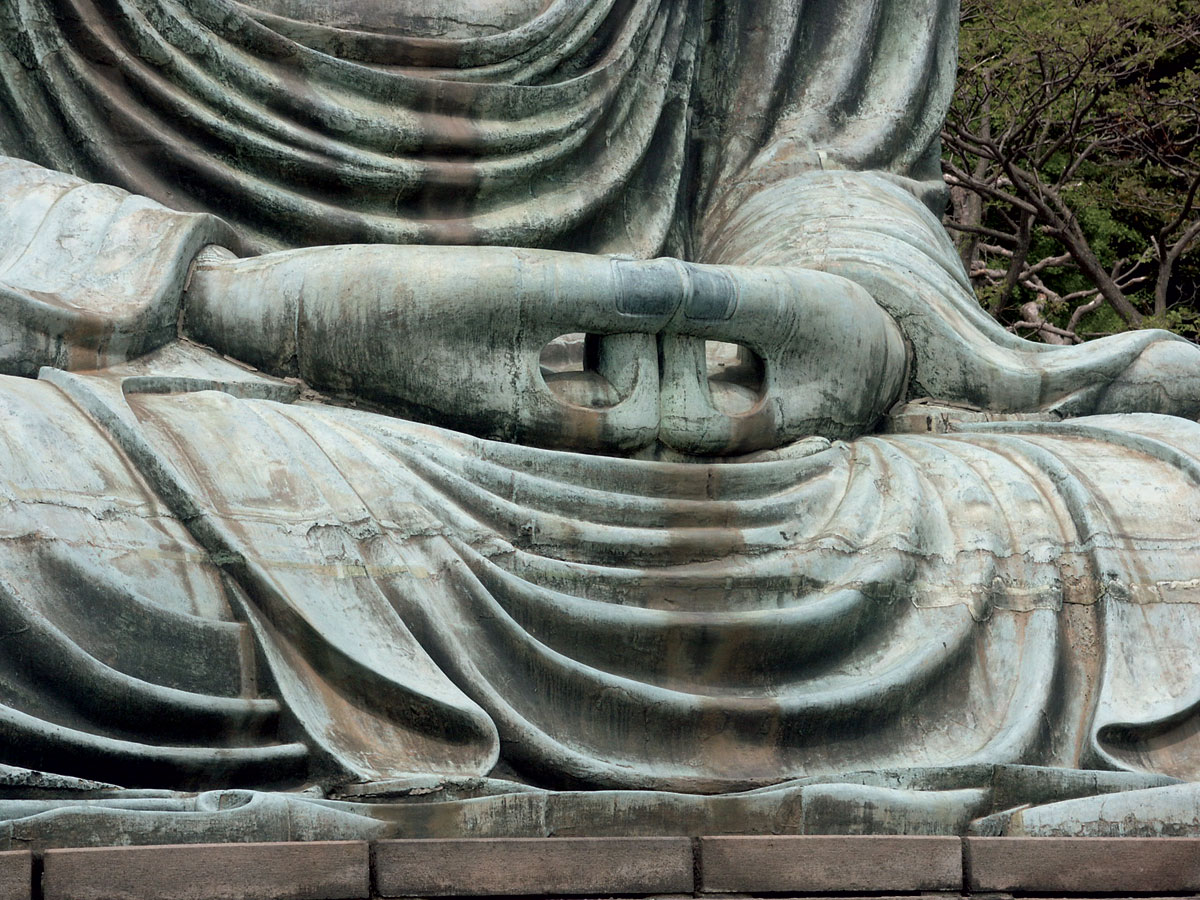
The monumental bronze Amida Buddha in Kamakura, Japan, did not always meditate in the open air. The original was made of wood and sheltered in a temple, but both were destroyed by a storm in 1248. It was recast in metal, covered in gold leaf and sheltered in a new hall. That hall was destroyed in 1334. It was rebuilt but damaged again in 1369. It was built again, only to be washed away in the tsunami of 1498. The weather-worn 13-meter, 93-ton Kamakura Buddha is not just a vivid reminder of Japan’s deep relationship with Buddhism but also of Japan’s fragile geography of earthquakes, typhoons and tsunamis – one that transforms the very idea of the Japanese built environment into a landscape of uncertainty, where things are temporary, fleeting, impermanent and unpredictable.
The idea of the city in common parlance may be founded on the idea of durability and permanence but not in Japan. To realize that Tokyo, one of the most populated and densest cities on the planet is situated on one of earth’s most fragile ecologies is to challenge some of the most fundamental logics of architecture, urbanity and city making.
Re-building as Ritual
Consider, for instance, Japan’s traditional choice of timber as a building material. Anyone who has seen Japan’s ancient burial mounts and pit dwellings or noted the construction precision at the base of its nine surviving castles can attest to their skill and knowledge of building with earth and stone. But interestingly, the magnificent white castles soaring above the massive stone plinths are made not of stone but wood. The Japanese chose for their dwellings, temples, and even their buildings of defense, a building material that was less resistant and more vulnerable to the perils of fires and natural disasters. Stone and earth, better suited to mediate the climatic extremes of humid summers and dry winters was ignored.
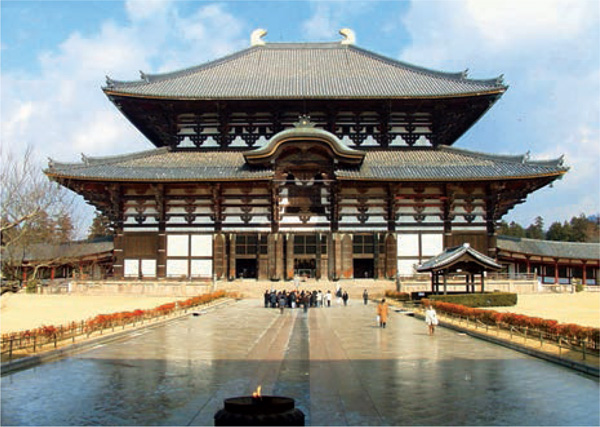 PHOTO: MICHAEL GREENHALGH | 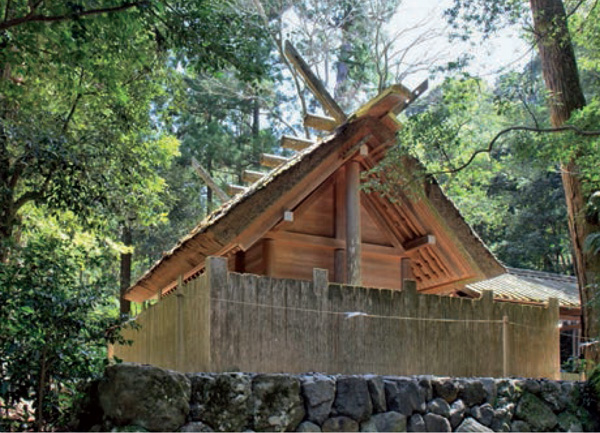 PHOTO: VINAYAK BHARNE |
Justifiably, the lightness of a timber building did make it less damaging in Japan’s seismic climate. Other cultures have pursued similar wisdoms. The Anasazi in the American south- west, for instance, built their dwellings with heavy earth walls to keep away the heat and cold but always had a light wooden roof. It did less damage to the inhabitants if it caved in due to heavy snow and could also be easily reconstructed. Also, as Jared Diamond has pointed out in his book Collapse, Japan has high rainfall and high fallout of soil-replenishing volcanic ash nurturing rapid tree growth. Its natural wildlife has had no goats or sheep whose grazing activities have devastated forest landscapes in other cultures. The abundance of sea-food also relieved pressure on forests as sources of both food and fertilizer. Japan’s incredible culture of wood presents its own logic when seen through these lenses.
But thanks to this obsession with an impermanent material, there is not a single traditional monument standing in Japan today that has not been rebuilt.
The Great Buddha Hall of the Todaiji Temple in Nara, once the largest wooden buildings in the world, has been rebuilt twice after its destruction by fire. The current building was finished in 1709, and although immense – 57 meters long and 50 meters wide – it is actually 30% smaller than its predecessor. In 1730, when the Great Nishijin Fire destroyed Kyoto’s Imperial Palace yet again, the Shogun simply ordered its reconstruction on an even grander scale, only to be burnt again in 1854 and replicated to its current form. In 2013, more than 100 timber buildings of the famous Ise shrines in Mie completed their 20-year cyclical rebuilding for the 62nd time. The rebuilding ritual called shikinen sengu and the two-decade-long period includes the harvesting, transporting and seasoning of the required timber followed by the re-construction. The Izumo shrine in Shimane is similarly renewed once every 60 years, and at the Suwa shrines in Nagano, 16 pillars from the two shrines are replaced with new ones every six years.
The traditional Japanese obsession with an impermanent building material and their willful acceptance of its uncertain future seems counterintuitive to other cultures that have always sought to build for permanence. The idea of monuments, communities, indeed entire cities being recurrently destroyed and built again may seem unsustainable, even irrational by today’s standards, yet this acknowledgement of transience and impermanence is a distinct Japanese cultural blue-print that stays alive to this day.
City as Flux
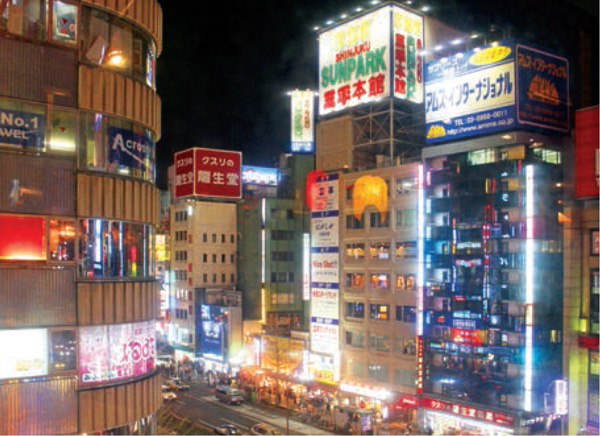
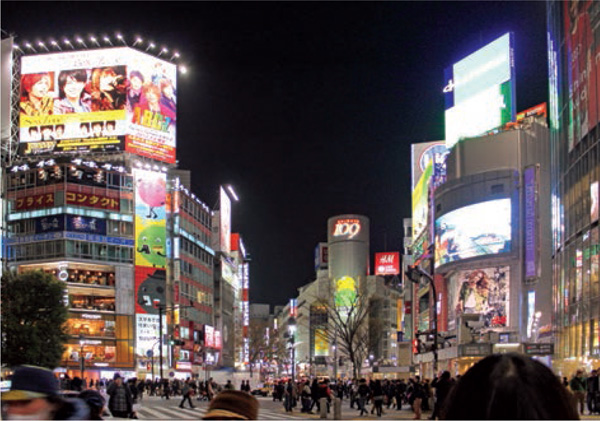
Today, Japan’s cultural propensity for constant change is also amusingly embodied in the commercial nodes of Ginza, Shinjuku and Shibuya. The identities of these districts are dominated by larger-than-life neon and other electronic signage covering entire buildings. The contorted latticed steel cages that hold the various signs may seem unappealing in the day, but come sundown and they transform into a riot of nocturnal electro-urbanism. These fluorescent skins and screens spewing moving images of products and events are recurrently changing and continually updated to keep up with Japan’s evolving consumerist tastes. And in observing Japan today, it occurs that it is not just the signage but the buildings themselves that are designed, not with the expectation of standing the test of time but to be torn down sooner than later and replaced by a new backdrop appropriate to the economic and technological spirit of the time.
 |  |
Photos: Vinayak Bharne | |
In his essay ‘What Goes Up Must Come Down,’ Botond Bognar has noted numerous instances of this bewildering phenomenon. In 1997, when he wrote the essay, the annual degree of change within Tokyo’s densely built urban zones was about 30%, going from façade improvements to entire new structures. The average life-span of a building was around 26 years. Virtually any building had a zero value after about three years even if built of reinforced concrete, the true value of the property lying in the ground alone. As recently as March 2011, the 140-meter-tall Grand Prince Hotel Akasaka, designed by the eminent Japanese architect Kenzo Tange was closed for demolition. Workers started at the top, working their way down. They inserted temporary supports and reinforced the top floor with steel beams to create adjustable lid. After an electric- powered crane removed all the material from each floor, the top floor and roof were lowered using massive jacks. From the outside, it appeared like nothing was going on, but in fact the hotel was quietly shrinking from the inside, some six meters every 10 days. By the end of spring 2013, the iconic building, like many of its predecessors, quietly disappeared – like a cherry blossom.
The Japanese architect Toyo Ito had once noted that, “if the Western city is a museum, then the Japanese city is a theatre.” He was referring to the constant changes happening in the physical landscape of metropolitan Japan, changes so rapid, that each decade could produce a physical setup quite different from its predecessor – like the changing scene of a play. The Japanese city, in this sense, epitomizes the notion that all cities are eventually phenomena in flux, events in time – some far more dramatic than others.
Disaster as Cyclical Occurrence
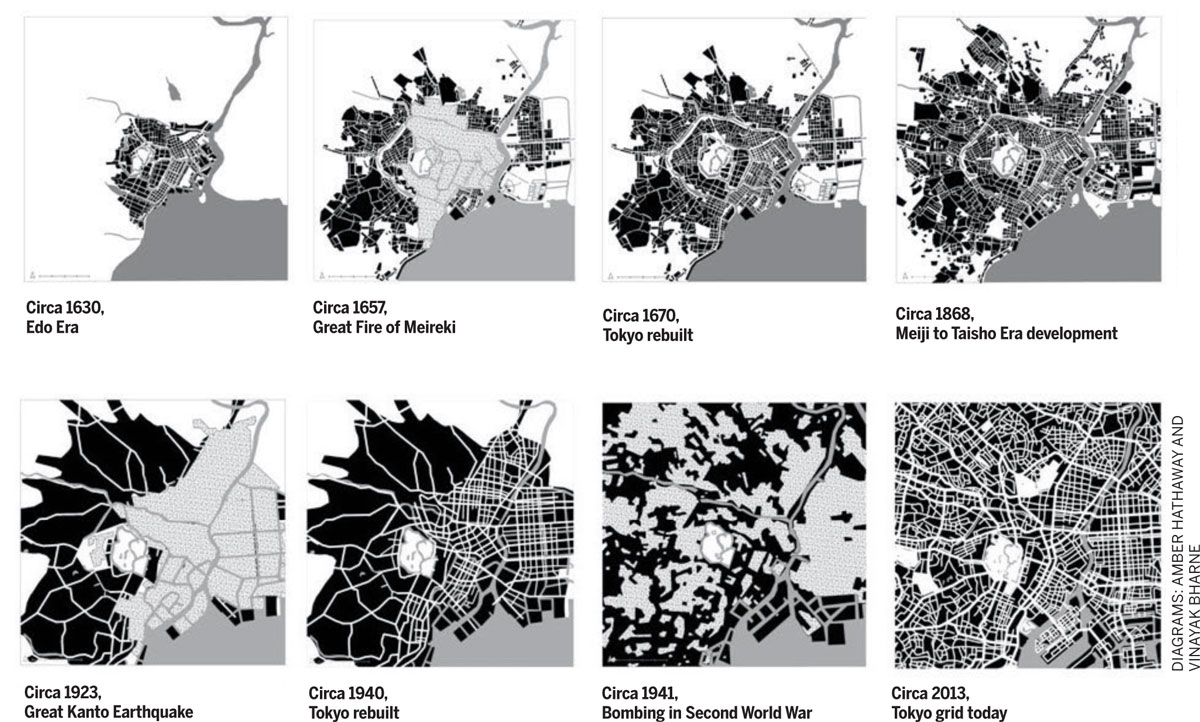
It is hard for many of us to contemplate living in a city that we know will be destroyed from time to time. But Tokyo appears to measure its history as events between disasters. In January 2012, the Earthquake Research Institute at the University of Tokyo reported a 70% chance of a 7.0-magnitude or higher quake to strike Japan’s capital by 2016. Such an event, the scientists said, could mean a death toll of up to 11,000 people and $1 trillion in damages in the world’s third-largest economy. Two years after the 9.0-magnitude quake and resulting tsunami devastated northeastern Japan, the country’s disaster-response experts are more nervous than ever about the ground beneath their feet. But Tokyo has seen this before. In 1923, after the 7.9-magnitude Great Kanto Earthquake destroyed more than half of its wooden buildings, succeeding reconstruction was guided by an ambitious plan with 16 experimental middle-class settlements built in as less as two years.
In Tokyo, disasters are a cyclical occurrence and responding to them is a seamless extension of its culture of uncertainty.
In Tokyo, as in many other places across the country, each district has its own evacuation spot, emergency road and temporary facilities with its own hazard maps showing areas of possible major damage and fire. For a long time, evacuation spots in Japan were located within the local community, with public schools and local parks as the main places for temporary evacuation. Today around 200 locations are registered within Tokyo for temporary emergencies including local parks, public schools, gas stations and convenience stores. There are also more than 30 larger designated evacuation open spaces (with a minimum area requirement of 90-square-kilometres) with hazard maps created by local communities and the city government, showing the emergency route for getting to these areas safely and directly.
Additionally, in 2012, The Tokyo Metropolitan Government announced a disaster preparation plan that uses the city’s fire hydrants as water stations for shelters in the event of an earthquake or similar disaster. According to the local government’s Bureau of Waterworks, roughly 130,000 fire hydrants throughout the city will be able to provide fresh water to as many as 5,000 refugee shelters, serving nearly eight million people who are predicted to be stranded in Tokyo in the event of a major earthquake. To turn fire hydrants into water stations, necessary supplies like water hoses and standpipes are being distributed to Tokyo’s wards, cities and towns.
In April 2012, it was determined that as much as 45% of Tokyo’s water supply could be cut off in a major earthquake leaving access to water only in stockpiled bottles and water tanks at the approximate 200 emergency supply bases throughout the city. Subsequently, the government has announced offering training programmes for residents on how to supply their own water.
In Tokyo, disaster preparedness towards unforeseen events is at work at all scales – from modest neighborhood-centered efforts and city-wide programmes to entire regional strategies – relying both on the old and familiar, as well as the new and innovative.
Beyond Formal Planning
In 1945, during World War II, before the annihilation of Hiroshima and Nagasaki, Tokyo suffered 70 air-raids. More than a fourth of the city and more than 700,000 houses were razed. In as less as two years, Tokyo’s population dropped by four million, a quarter as victims of the war. But even though it appeared as if Japan could not hope to recover, the 1950s saw not only an overwhelming population increase, but also the beginnings of even greater economic growth. Within 20 years since what seemed like an apocalypse, Tokyo was one again reborn.
Tokyo’s post-war recovery plan was centered on its decentralization at both a regional and city scale. It began with the building of multiple centers like Shibuya, Ikebukuro and Shinjuku, followed by Asakusa, Osaki and Kameido and eventually spreading into the reclaimed islands within the Tokyo Bay. The government initially focused on infrastructure and disaster relief, but gradually, deviating from the plan’s most ambitious recommendations, left housing and commercial development to local forces. While public housing systems such as the Public Operated Housing (POH), and the Housing and Urban Development Corporation (HUDC) built dwellings to be rented or sold to the more needy classes, this was a small part of the 11-million-odd new dwelling units that cropped up between the late ’50s through the early ’70s. Most of these were single-family ownership homes and modest rental units, all managed by private parties and created by the local construction industry, relying on homeowner participation and traditional building practices. By 1960, Tokyo had more than nine million residents, living in an expensive city that had in a desperate drive of rapid reconstruction, swallowed up its surrounding countryside.
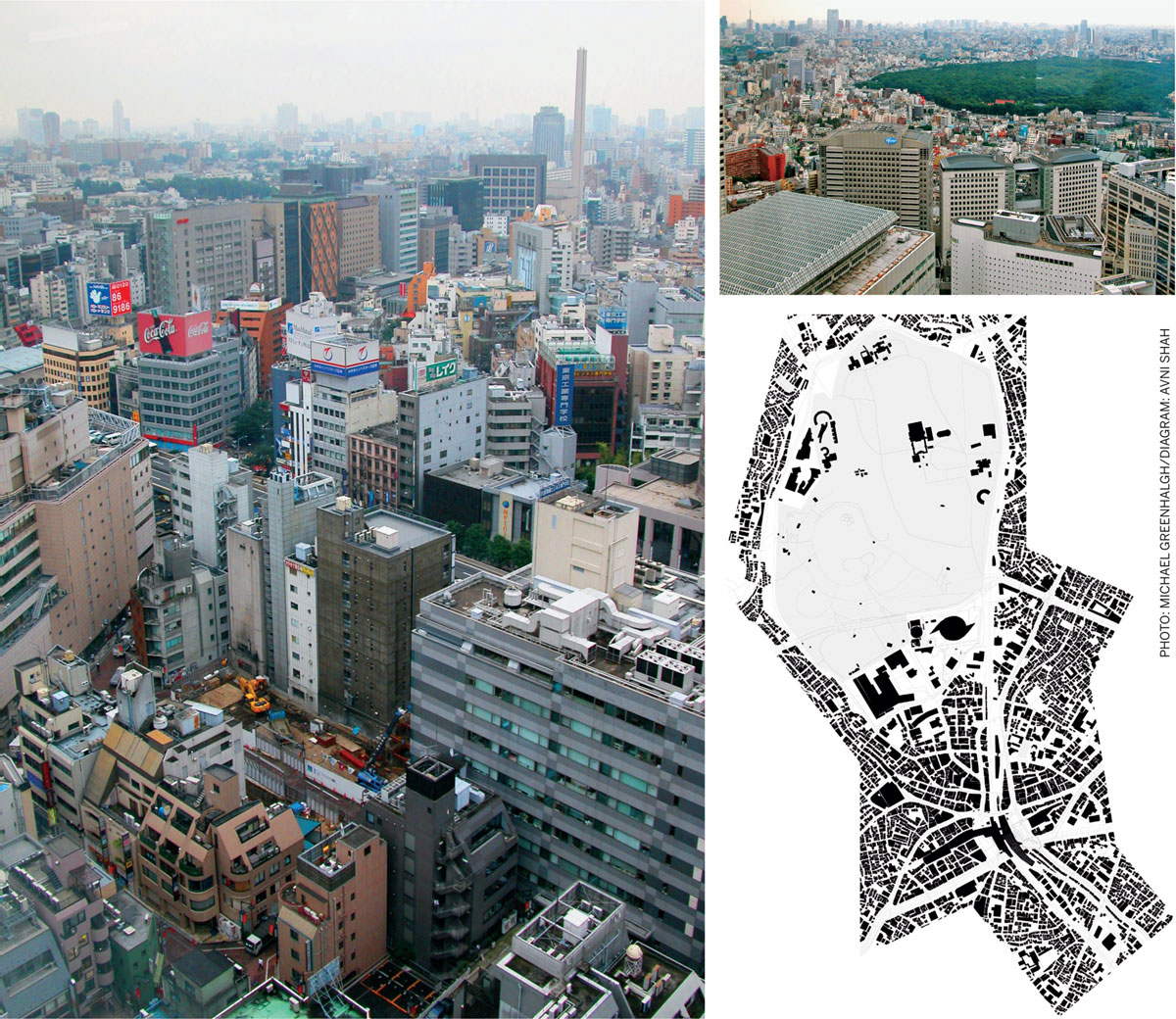
Top Right: View of high and low-rise development surrounding Yoyogi Park and Meiji Shrine, Tokyo. Note the sheer density and lack of figural urban form
Bottom Right: Mapping of area around Yoyogi Park, Tokyo. Note the warping street grid that has emerged in response to the hilly terrain. The long megastructure to the bottom is Shibuya Station. The circular building in the center is the Yoyogi Stadium. The vast open space is the Yoyogi Park and Meiji Shrineprecinct
Tokyo, in the wake of its uncertain circumstances, thus reveals a unique urban evolutionary pattern. It consists of spasms of urban destructions and their replacement with entirely new urban patterns and grids many having evolved without any formal planning. Tokyo’s visual ambiguity therefore should not be misunderstood. It is a reminder that urban form can in fact be shaped by various other forces beyond those of formal planning and design, and that the livability quotient of a city can in fact transcend its physical and visual clarity.
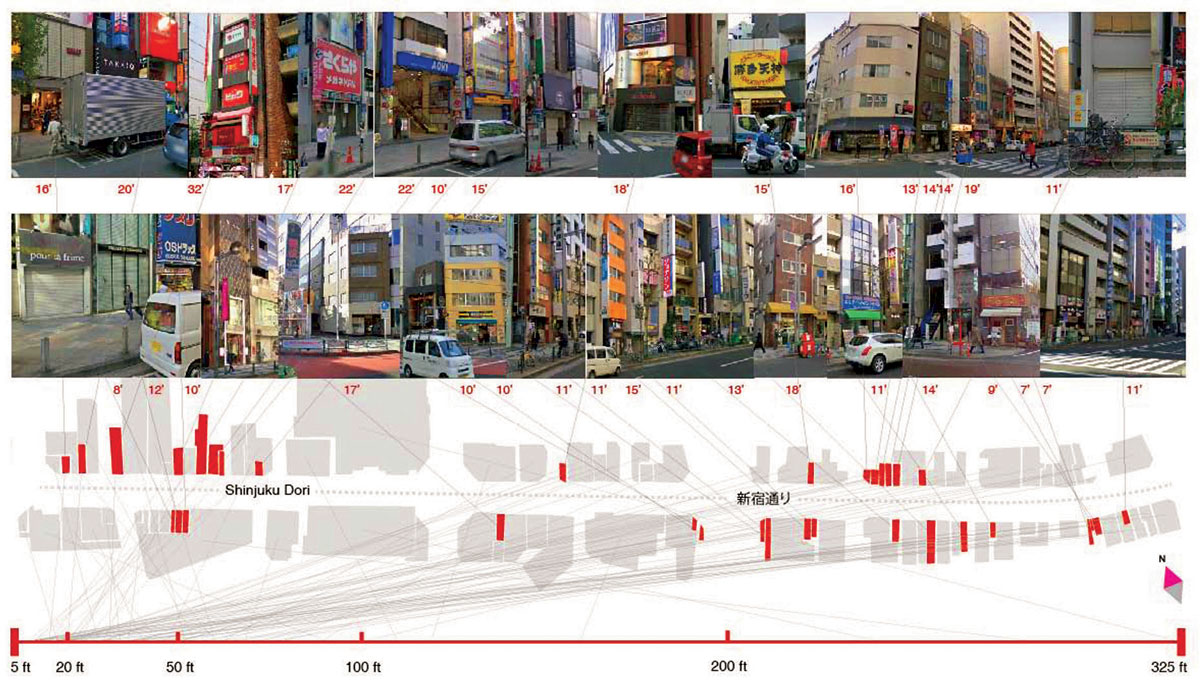
DIAGRAM: XIN XIN
The Truism of Uncertainty
Even before Buddhism entered Japan in 538 CE, its early Shinto traditions had developed a keen sensitivity to temporality and impermanence. In Shintoism, it was believed that the divine kami (nature spirits) dwelled in natural elements such as trees and mountains intermittently, and through this cyclical possession, brought about a constant flux in the perceived nature of the place. The frame of time between the kami’s coming and going from the object was overtly expressed in the term ma, implying a non-eventful gap, a temporal moment between two different phenomena. The establishment of Buddhism with its philosophical emphasis on transience and change reinforced this Shinto sensitivity to temporality. The Buddhist notion of mujo (literally ‘impermanence’) gradually became the philosophical backbone of Japanese culture. The Japanese acknowledgement of the changing seasons, the cyclical rebuilding of their shrines, the constant rebuilding of entire habitats and their unique attitude towards unpredictable events, must all be understood as the evolution of a deep cultural psychology shaped as much by religion and philosophy as the realism of an uncertain ecology in which the culture is rooted.
The Japanese city then is an urban phenomenon where the notion of uncertainty changes from fear to a way of life, where the idea of impermanence is embraced as a natural inevitability, where the term disaster translates into cyclical occurrence and where the term density translates into a mechanism for survival. To think that cities like Tokyo are exceptional or anomalous is an exaggeration born out of a comparative bias from the standpoint of our own cities that have yet to adapt, mentally and physically, to the idea of fragile circumstances, rapid change and unpredictability. Tokyo might not be a physical model for other cities, but its livability, compact footprint, access to mass transit and impeccable efficiency are things every other city can aspire to. And to recognize that this is all framed within an uncertain geology of sudden disasters and catastrophes makes it all the more worthy of study and attention. The Japanese city, seen from the standpoint of its resilience, adaptability, tolerance and open-endedness, compels us to reconsider the very definitions of disaster planning, urbanism, architecture and policymaking. If we can learn to read the Japanese city on its own terms, overcoming our preconceptions and biases, it can offer us invaluable takeaways to expand our understanding of what cities are and how we might inhabit and experience them.

Comments (0)